


Why has China sharply increased its imports of Vietnamese lobster?
Vietnamese green lobster (150–300 grams per piece) – a product that is currently highly favored in the Chinese market. In 2025, Vietnam’s lobster exports to China surged dramatically, reaching a record USD 858 million, up 208% compared to 2024. China became Vietnam’s largest lobster import market, accounting for nearly the entire lobster export turnover (USD 845 million).
Below is an analysis of the key reasons behind China’s sharp increase in lobster imports from Vietnam in 2025, examined from the perspectives of market demand, trade and quarantine policies, pricing and production, bilateral trade relations, and competition among supplier countries.
China’s increased imports of Vietnamese lobster in 2025 were the result of multiple converging factors. On the demand side, China’s growing middle and affluent classes have an expanding appetite for premium cuisine, viewing lobster as both a delicacy and a symbol of good fortune during festive occasions. On the supply side, Vietnam responded swiftly by focusing on farming permitted lobster species, expanding production scale, and meeting stringent quarantine standards. Vietnam–China trade relations also improved significantly, creating smoother official export channels with tariff incentives.
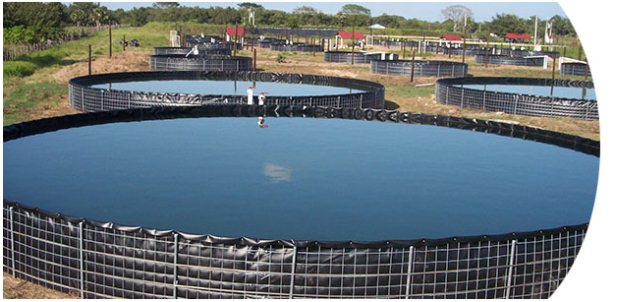
In addition, shifts in international competition (especially the absence of Australian lobster and tariff barriers on North American products) created favorable conditions for Vietnamese lobster to capture market share. With impressive growth momentum (lobster exports to China more than tripled within a year), Vietnam is emerging as a key lobster supplier to China. However, to sustain and strengthen this position, Vietnam must continue improving quality, stabilizing supply, and proactively adapting to new standards as well as the potential return of competitors in the future.
Why Did China Significantly Increase Imports of Vietnamese Lobster?
1. Rising Demand from the Chinese Market
Premium consumption trends:
Chinese consumers increasingly prefer high-quality, safe, and traceable seafood products and are willing to pay premium prices for distinctive culinary experiences. Instead of focusing on low-cost frozen shrimp, they are shifting toward premium segments such as large-sized shrimp, live/fresh lobster, and value-added processed products for restaurants and hotels. This shift in preferences has strongly boosted demand for Vietnamese lobster, which is highly regarded for its quality and suitability for the premium segment.
Festive season and cultural factors:
Lobster demand in China surges during Lunar New Year, when households prepare for year-end celebrations. Lobster is popular at banquets due to its attractive appearance and bright red color symbolizing luck and prosperity. In particular, smaller-sized lobsters (150–300 grams per piece) are highly favored at the increasingly popular seafood buffet restaurants in China.
Economic recovery and stimulus policies:
After reopening post-COVID-19, China experienced income recovery alongside government policies aimed at stimulating domestic consumption. As a result, demand for premium foods such as lobster increased further. In 2025, rapid growth in e-commerce and modern retail chains also helped imported lobster reach consumers more widely. Thanks to a population of over one billion willing to spend, China’s total lobster imports in the first three quarters of 2025 reached nearly 49,900 tons, up 13% year-on-year. This surge created major opportunities for suppliers such as Vietnam.
2. More Favorable Trade and Quarantine Policies
Market access and tariff incentives:
Vietnam–China trade relations in agriculture and seafood have seen significant positive developments in recent years. China has approved official import protocols for many Vietnamese agricultural products through bilateral agreements. Notably, key Vietnamese seafood products such as lobster, black tiger shrimp, and pangasius now enjoy zero import tariffs under free trade agreements (ACFTA, RCEP).
With a 0% tariff advantage (and no punitive duties), Vietnamese lobster is far more price-competitive than lobster from the United States and Canada, which face import tariffs of approximately 17% and 32%, respectively. Additionally, Vietnam’s geographic proximity shortens transportation time for live lobster shipments to China, reducing mortality rates and logistics costs. These factors provide clear trade advantages and encourage China to increase imports from Vietnam.
Quarantine regulations and import controls:
In 2023, China amended its Wildlife Protection Law (effective May 2023) and added ornate spiny lobster (Panulirus ornatus) to its Category II protected species list. Under the new regulations, harvesting and trading wild ornate spiny lobster is prohibited, and only farmed lobster may be imported under strict conditions, including proof of farming processes and the use of hatchery-produced seed stock (F2 generation or later). Chinese importers must obtain special wildlife permits, and Vietnamese farming and packing facilities must be registered and approved before export.
These tightened regulations initially disrupted Vietnam’s lobster exports in early 2023, with export value in the first eight months reaching only USD 76 million, down 42% year-on-year. However, both governments worked actively to resolve the issue. China agreed to consider a special mechanism for farmed ornate lobster and conducted online inspections of farming facilities. Meanwhile, Vietnam’s Ministry of Agriculture encouraged farmers to shift toward farming green spiny lobster (Panulirus homarus), which is permitted for import and most favored by the Chinese market.
Exporter adaptation:
By 2025, exports to China had stabilized under official channels. Vietnam now has 46 live seafood packing facilities (mainly lobster) approved by Chinese authorities. Exporters have strictly complied with traceability requirements, piloted labeling programs in Phu Yen province, and enhanced quality control standards.
As a result, quarantine barriers are no longer a major obstacle. China continues to import large volumes of green lobster from Vietnam, while ornate lobster is temporarily consumed domestically. By the end of 2024, China still prohibited ornate lobster imports and allowed only green lobster, providing clear direction for Vietnamese farmers. Chinese customs authorities have also emphasized closer agricultural cooperation and the simplification of procedures when quality standards are met.
(Note: China is expected to implement Order 280 from mid-2026 with stricter export facility registration requirements. However, in 2025, current regulations remain favorable for Vietnamese lobster exports.)
3. Vietnam’s Lobster Production Capacity
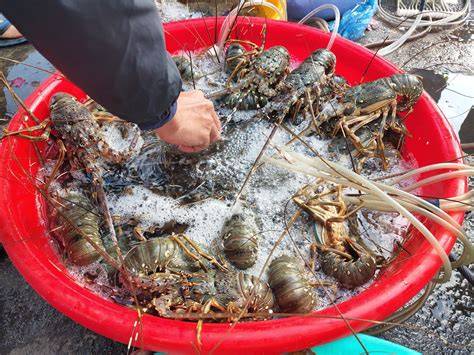
To meet China’s enormous demand, Vietnam has expanded lobster farming in recent years. Key farming areas such as Xuan Dai Bay (Phu Yen) and Cam Ranh (Khanh Hoa) have recovered production levels, forming a strong export base.
China imported 17,365 tons of lobster from Vietnam in the first three quarters of 2025 (nearly triple the same period in 2024), valued at USD 556 million. Farming cages have increased rapidly, with over 27,000 cages in Song Cau (Phu Yen) alone.
Despite strong growth, farmers face risks from natural disasters and disease outbreaks. Historic floods in late November 2025 in Phu Yen caused mass lobster mortality, which may reduce supply in early 2026 and push prices upward. Sustainable farming models and better environmental control are being promoted to ensure long-term stability.
4. Shifts in Vietnam–China Trade Relations
In 2025, China surpassed the United States to become Vietnam’s largest seafood export market. Trade has shifted from informal border transactions to official channels, reducing risks and improving price stability.
China is also diversifying suppliers amid trade tensions with Western countries. The import ban on Australian rock lobster since late 2020 created a significant market gap. While relations improved by late 2024, Australian lobster had not fully returned in 2025, allowing Vietnam to expand its market share significantly.
5. Competition and Vietnam’s Market Position
Australia’s absence:
Australia previously accounted for 50% of China’s lobster imports (2019). Its absence created a major opportunity for Vietnam.
Decline in North American supply:
High tariffs have reduced imports from Canada (-39%) and the United States (-10%) in 2025. Vietnamese lobster benefits from zero tariffs and faster delivery.
Other competitors:
New Zealand and Mexico remain major suppliers, but Vietnam is emerging strongly in the tropical small-sized lobster segment thanks to competitive pricing and stable supply.
In 2025, Vietnam is estimated to account for nearly 40% of China’s lobster import value, becoming the fastest-growing supplier. Vietnamese lobster is regarded as a luxury delicacy among affluent Chinese consumers willing to pay premium prices—representing a golden opportunity for Vietnam’s lobster industry to strengthen its global position and brand.
Source: Vasep
AQUA MINA CO., LTD
– Address: 685 Le Duc Anh Street, Quarter 39, Binh Hung Hoa Ward, Ho Chi Minh City
– Phone: 1800 6071 (Toll-free hotline)
– Email: sales@aquamina.com.vn or oversea@aquamina.com.vn
– Aqua Mina’s Official Distributor in Japan: REX INDUSTRIES CO., LTD
– Address: 1-9-3 Hishiya-Higashi, Higashi-Osaka 578-0948, JAPAN
– Email: kimakubo@rexind.co.jp
– Phone: +81-(0)72-961-9893
– Website: www.rexind.co.jp/e/

WE WORK FOR THE SUCCESS
Ngày đăng : 03/03/2026
1138 View


Other Articles
OFFICIAL OPENING of the International-Scale Aquaculture Exhibition Series | See You Again with AQUA MINA at VietShrimp Asia 2026
VietShrimp Asia & Aquaculture Vietnam 2026 | Smart Aquaculture – The AI Revolution in Aquaculture
AQUA MINA AT VIETSHRIMP 2026 – GET UP TO 40 MILLION VND IN DISCOUNTS WHEN PURCHASING AQUA MINA TURBO AQUACULTURE BLOWERS
22 kW Turbo Blower with Pneumatic Suspension vs. Suplang Blower – Which Is the Better Choice for Shrimp Ponds? Contact: 1800.6071 (Toll-free)
TURBO BLOWER FOR AQUACULTURE AND TRADITIONAL SUPLANG BLOWER – OPERATIONAL PERFORMANCE COMPARISON Hotline: 1800.6071 (Toll-free)
AQUA MINA 7.5 kW SUSPENDED AERATION BLOWER FOR AQUACULTURE – DISTINCT PERFORMANCE COMPARED TO TRADITIONAL SUPLANG BLOWERS IN SHRIMP FARMS
TURBO BLOWER – ADVANCED AERATION TECHNOLOGY THAT SAVES ENERGY COMPARED TO SUPLANG BLOWERS IN SHRIMP FARMING
15 kW TURBO BLOWER FOR AQUACULTURE – WHAT MAKES IT DIFFERENT? A COMPARISON WITH TRADITIONAL BLOWERS
Tensions in the Strait of Hormuz: Vietnam’s USD 401 Million Seafood Exports Enter a Challenging Zone
The Middle East Erupts in Tension, Import–Export Department Issues a Series of Urgent Recommendations
Benefits of Exogenous Protease in Whiteleg Shrimp Farming



.jpg)