


Indonesia’s shrimp industry today: The promise and risks of integrated mega-farms
Indonesia stands among the world’s largest shrimp producers, yet its shrimp industry today reflects a complex mix of scale, untapped potential, and structural vulnerability. While national production volumes are significant, productivity gaps, technological disparities, and sustainability challenges continue to shape the sector’s trajectory. Against this backdrop, the government’s push for large-scale integrated shrimp farming, most notably in Waingapu, East Sumba, marks an ambitious attempt to redefine Indonesia’s shrimp future.
Current production
According to Tb Haeru Rahayu, Director General of Aquaculture at the Directorate General of Aquaculture under the Ministry of Marine Affairs and Fisheries (KKP), Indonesia’s shrimp production currently stands at approximately 1.2–1.3 million tons per year, generating export revenues of USD 1.6–2.2 billion, within a total shrimp industry value estimated at US$5.5 billion. This places Indonesia firmly among the top global producers, alongside China, India, Ecuador, and Vietnam.
However, production scale masks underlying inefficiencies. Roughly 80% of shrimp ponds nationwide still operate under traditional systems, with limited technology adoption, low stocking densities, and higher vulnerability to disease. Semi-intensive and intensive systems, where productivity per hectare is significantly higher, remain the minority. As a result, Indonesia’s output per unit area lags behind competitors such as Ecuador, which has rapidly modernized its shrimp farming practices.
Export dependence also poses risks. Around 67–70% of Indonesian shrimp exports are shipped to the United States, exposing producers to market concentration risk, regulatory shifts, and price volatility. Diversifying both markets and product forms has therefore become a strategic priority.
Learning from Dipasena
The renewed focus on integrated shrimp estates draws inspiration from Indonesia’s own history. In the 1990s, the Dipasena integrated shrimp complex in Lampung became one of the largest in the world, spanning over 16,000 hectares and producing up to 200 tons of shrimp per day. The model demonstrated the power of scale, centralized infrastructure, and synchronized upstream–downstream operations.
Today’s policymakers hope to replicate this success within a modern framework that emphasizes biosecurity, traceability, and environmental management, key demands of global seafood markets.
Waingapu: A new flagship for Indonesian shrimp
The most ambitious of these efforts is the integrated shrimp farm planned in Waingapu, East Sumba, East Nusa Tenggara (NTT).
According to Tb Haeru, the project is designed as a post-reform “modeling project” for the national shrimp industry. “NTT’s contribution is still relatively small today, but within two years, Waingapu alone is expected to supply at least 52,000 tons of shrimp annually,” Tb Haeru said.
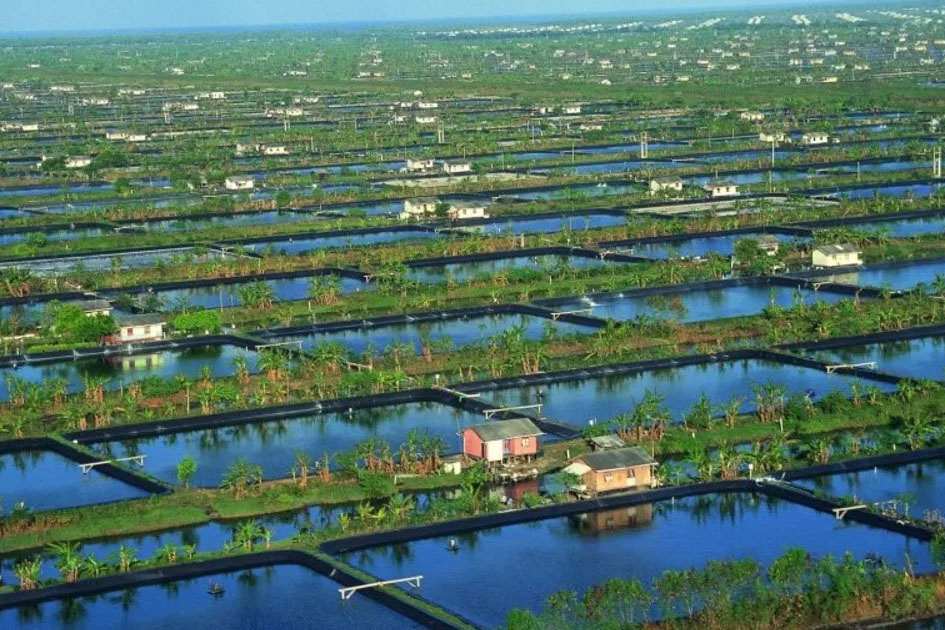
The project will span approximately 2,000 hectares, with 1,300 hectares allocated to shrimp ponds and the remainder dedicated to supporting infrastructure. Designed as a fully integrated estate, the complex will include hatcheries, feed supply, ice plants, cold storage, wastewater treatment, and processing facilities, all located within one ecosystem. Vannamei shrimp will be the primary species cultivated.
At full capacity, Waingapu will consist of 12 production clusters, each containing 128 ponds. Initial operations will begin with two clusters, allowing gradual scaling and operational learning. The project is financed through a foreign private loan (KSA) scheme valued at around USD 416 million, with technical financing oversight under the Ministry of Finance.
Technologically, Waingapu represents a significant leap from traditional pond systems. Centralized water intake, biosecure pond layouts, integrated wastewater treatment (IPAL), and cold-chain logistics are intended to produce premium-grade shrimp with strong traceability, key to meeting increasingly strict international standards.
However, experience from earlier projects underscores that scale alone does not guarantee success.
Beyond production volume, the project is expected to generate thousands of jobs, stimulate regional economic growth, and support export market diversification to Europe, East Asia, and the Middle East.
Kebumen: A cautionary tale
The integrated shrimp farm previously developed by KKP in Kebumen, Central Java, covered only around 100 hectares, tiny compared to Waingapu’s footprint. Yet despite its smaller scale, the project faced significant operational challenges. According to an unnamed source familiar with the site, the facility, officially inaugurated in March 2023, ceased operations by August 2025.
Infrastructure damage proved a critical issue. Seawater intake pipelines were reportedly destroyed by waves, concrete supports collapsed, and metal fastenings corroded. Partial harvests conducted in mid-2025 were followed by prolonged downtime, with many ponds failing to refill adequately.
A source noted that the intake system not only drew seawater but also unintentionally captured marine organisms such as crabs, groupers, and shellfish, raising ecological concerns.
These issues were echoed in a Supreme Audit Agency (BPK) report released in January 2025, which criticized the lack of comprehensive infrastructure-based analysis in setting production targets. As a result, realized output reached only 40.6% of the target in 2023, falling further to 22.4% in 2024. Quesions surrounding wastewater treatment effectiveness, environmental impacts, and long-term viability ultimately clouded the project’s future.
Balancing scale, technology, and governance
Government officials acknowledge that lessons from Kebumen are shaping the Waingapu approach. Better site selection, stronger coastal engineering, and more robust environmental safeguards are expected to mitigate similar risks. Still, challenges remain, particularly Waingapu’s remote location and limited air connectivity, which could complicate logistics and oversight.
Indonesia’s shrimp industry today stands at a decisive juncture. If Waingapu succeeds, it could significantly lift national production curves, accelerate technology transfer, and reposition Indonesia as a supplier of premium, responsibly farmed shrimp. If it falters, it will reinforce concerns that mega-projects without meticulous execution risk becoming costly experiments.
As Tb. Haeru emphasized that integrated shrimp farming is not merely about building ponds, but about building systems. The coming years will determine whether Waingapu becomes Indonesia’s next Dipasena, or a reminder that sustainable aquaculture depends as much on governance and resilience as it does on scale.
Source: aquafeed
AQUA MINA CO., LTD
– Address: 685 Le Duc Anh Street, Quarter 39, Binh Hung Hoa Ward, Ho Chi Minh City
– Phone: 1800 6071 (Toll-free hotline)
– Email: sales@aquamina.com.vn or oversea@aquamina.com.vn
– Aqua Mina’s Official Distributor in Japan: REX INDUSTRIES CO., LTD
– Address: 1-9-3 Hishiya-Higashi, Higashi-Osaka 578-0948, JAPAN
– Email: kimakubo@rexind.co.jp
– Phone: +81-(0)72-961-9893
– Website: www.rexind.co.jp/e/

WE WORK FOR THE SUCCESS
Ngày đăng : 25/02/2026
1396 View


Other Articles
DAY 1 – AQUA MINA | A POWERFUL OPENING AT VIETSHRIMP ASIA 2026
OFFICIAL OPENING of the International-Scale Aquaculture Exhibition Series | See You Again with AQUA MINA at VietShrimp Asia 2026
VietShrimp Asia & Aquaculture Vietnam 2026 | Smart Aquaculture – The AI Revolution in Aquaculture
AQUA MINA AT VIETSHRIMP 2026 – GET UP TO 40 MILLION VND IN DISCOUNTS WHEN PURCHASING AQUA MINA TURBO AQUACULTURE BLOWERS
22 kW Turbo Blower with Pneumatic Suspension vs. Suplang Blower – Which Is the Better Choice for Shrimp Ponds? Contact: 1800.6071 (Toll-free)
TURBO BLOWER FOR AQUACULTURE AND TRADITIONAL SUPLANG BLOWER – OPERATIONAL PERFORMANCE COMPARISON Hotline: 1800.6071 (Toll-free)
AQUA MINA 7.5 kW SUSPENDED AERATION BLOWER FOR AQUACULTURE – DISTINCT PERFORMANCE COMPARED TO TRADITIONAL SUPLANG BLOWERS IN SHRIMP FARMS
TURBO BLOWER – ADVANCED AERATION TECHNOLOGY THAT SAVES ENERGY COMPARED TO SUPLANG BLOWERS IN SHRIMP FARMING
15 kW TURBO BLOWER FOR AQUACULTURE – WHAT MAKES IT DIFFERENT? A COMPARISON WITH TRADITIONAL BLOWERS
Tensions in the Strait of Hormuz: Vietnam’s USD 401 Million Seafood Exports Enter a Challenging Zone
The Middle East Erupts in Tension, Import–Export Department Issues a Series of Urgent Recommendations


.jpg)